Thursday, January 23, 2025

What is Truth?

Jeremiah 2:11-13                          Ephesians 5:6-17                     John 18:28-40

What is Truth?

Pilate’s question, “What is truth?” (John 18:38), echoes through the ages, but especially in times when those entrusted with upholding God’s Word deviate from it. How does one define truth amid a smorgasbord of options that all claim to be true? Can truth change or adapt? Can God change his position on truth? We all know how we feel about flipflopping politicians…but are we ok with a flipflopping Church, or worse…a flipflopping God? Are there non-negotiable boundaries that delineate truth, and how are we to determine the limits of these borders? What is truth?

The trial of Jesus provides us with a striking example of how human agendas can distort the truth. Recent decisions by revisionists in the Church demonstrate a troubling parallel, as cultural pressures lead to the compromise of Scriptural authority.

The Sanhedrin was the Jewish ruling council, responsible for interpreting and applying God’s law. In other words, they were seen as custodians of God’s truth. Yet, despite their role, the Sanhedrin blatantly and knowingly violated Scriptural principles during Jesus’ trial. Not only had they paid Judas to betray him, but they had held the trial at night, against Jewish legal standards (Deuteronomy 16:18-20). They had relied on false witnesses (Exodus 20:16) and they had prioritized political expediency over justice (John 11:50). And finally, they delivered one of their own to be tried by an unrighteous, pagan governor (see 1 Corinthians 6:1).

Those among the leaders who did believe that Jesus was who he claimed to be, failed to openly acknowledge their faith in him because they were afraid they might be ridiculed or excommunicated. As John put it: “they loved human praise more than praise from God.” (John 12:42-43) For example, Nicodemus came to Jesus under cover of darkness (John 3:1-21) and only cautiously challenged the Pharisees’ misuse of the law, backing down immediately after they dismissively mocked him (John 7:45-52).  Joseph of Arimathea remained a secret disciple of Jesus, right up until after the crucifixion, because he feared the Jewish Leaders (John 19:38). These men wanted to keep their seats in government and, no doubt, their comfortable lifestyles, and so they said and did little that might jeopardise their future. As Edmund Burke reputedly once said: “The only thing necessary for the triumph of evil is for good men to do nothing.”

But what is worse, is that the ecclesiastical leaders had led the people astray. On one level, they had kept them ignorant, calling them an accursed rabble who did not know the law (John 7:49), but on another level they had added so many extrabiblical rules and regulations that the truth had become totally obscured. Quoting Isaiah, Jesus said of the Pharisees and Scribes: “This people honours me with their lips, but their heart is far from me; in vain do they worship me, teaching as doctrines the commandments of men.” (Matthew 15:8-9) And all too often, as the leadership goes, so go the people.

In short, it was a classic case of the blind leading the blind. The ecclesiastical leaders were twisting truth to suit their agenda. They rejected Jesus because he threatened their power and their political positions (John 11:48) and they obstinately chose to ignore his truthful and authoritative teaching as well as his corroborating powerful humanly unexplainable deeds.

Now, like the Sanhedrin, the revisionists in the Church, many of whom hold a position of spiritual leadership and have been entrusted to faithfully teach and uphold the Word, have exhibited a total disregard for Scripture. Unlike the liberals of yesteryear, these new revisionists no longer seek to reinterpret certain Scriptures to suit their agendas, but rather they agree with the plain meaning of these texts but they deliberately choose to disregard them because they believe truth has changed.

This is no longer undermining the authority of Scripture (2 Timothy 3:16) to conform to cultural trends that dictate theological shifts. This is no longer twisting truth for Cultural Relevance. No, this is a declaration that truth as defined by Scripture is no longer relevant because truth (or some will even dare to say God) has changed. The Church’s desire to appear inclusive and relevant has led to compromises that prioritize societal approval over Scriptural fidelity. Like the Sanhedrin, there’s a tendency today to not reinterpret God’s Word to fit human agendas, but rather to ignore God’s Word as written, replacing it with “the commandments of men”. 

In Jeremiah 2:11-13, God asked: “Has a nation (and he was talking about pagan nations) changed its gods, even though they are no gods? But my people have changed their glory for that which does not profit. Be appalled, O heavens, at this; be shocked, be utterly desolate, declares the Lord, for my people have committed two evils: they have forsaken me, the fountain of living waters, and (they have) hewed out cisterns for themselves, broken cisterns that can hold no water.” (ESV) 

One may well ask today if our church has changed its God. Since God declares in Scripture that he does not change (Malachi 3:6), if, as the revisionists claim, the god of the church does and has changed, well then, it can no longer be God in our church, can it? It must be something else…some other god.

But at this point in our Gospel story, another party is introduced. Pilate, the pagan Roman governor. Note that although the religious leaders regarded this man with contempt and refused to so much as cross his threshold lest they be ceremonially defiled, they were eager to seek his assistance in their bid to extinguish the Light that consistently exposed their lack of religious reality. Well did Jesus say of them, “Woe to you, scribes and Pharisees, hypocrites! For you clean the outside of the cup and the plate, but inside they are full of greed and self-indulgence. You blind Pharisee! First clean the inside of the cup and the plate, that the outside also may be clean.” (Matthew 23:25-26)

You see, there’s no point in going through the external motions of religiosity if there is no internal basis for such behaviour. If you deny the validity or veracity of the Word of the One you claim to follow, you really aren’t following him now, are you? Then at least be honest and walk away from his Church…don’t try to recreate his Church to mirror your own or society’s image.

And yet, defying all logic, it is at the praetorium, the very symbol of Roman judgement and oppression and everything the leaders defined as unclean, it is there that they seek to extinguish the truth. False piety has no limit to the extent to which it will stretch to keep itself from being exposed as worthless and meaningless. 

They knew they had no legitimate charge to bring against Jesus and yet when Pilate indicated that he knew that too, they were offended. “If this man were not doing evil, we would not have delivered him over to you.” Now Pilate may have been many things, but he was not a fool. He knew he was being used here. If there was no charge specifically relating to Roman law, well then, they ought not to have expected him to conduct a Roman trial.

However, according to Roman law, no one in any occupied territory was allowed to put someone to death. This was more than likely an attempt to protect those who were sympathetic to Rome and thus judged to be traitors by their own people. Nevertheless, this is why the leaders countered Pilate’s attempted dismissal with this fact: it was not lawful for them to put anyone to death. 

And so, at this point their true hearts were exposed. They wanted him dead. As Jesus said in John 8:44, “You are of your father the devil, and your will is to do your father's desires. He was a murderer from the beginning, and does not stand in the truth, because there is no truth in him. When he lies, he speaks out of his own character, for he is a liar and the father of lies.” 

But because the leaders were not allowed to put Jesus to death – a regulation, by the way, they did not always follow, as in the case of Stephen – Jesus would not be stoned to death as was the Jewish custom, but rather he would be crucified which was the Roman custom for non-Roman citizens. John interpreted this as an act of providence. In numerous places, Jesus had indicated that his death would be a result of being “lifted up”. In John 3:14 he is recorded as having said: “…as Moses lifted up the serpent in the wilderness, so must the Son of Man be lifted up…” Then later as in John 12:32: “And I, when I am lifted up from the earth, will draw all people to myself.” But more specifically, as Matthew recorded Jesus statement in chapter 20 of his Gospel (20:18-19): “See, we are going up to Jerusalem. And the Son of Man will be delivered over to the chief priests and scribes, and they will condemn him to death and deliver him over to the Gentiles to be mocked and flogged and crucified, and he will be raised on the third day.”

It is interesting to note that the Early Church interpreted the trial and execution of Jesus as a fulfilment of David’s prophetic words as recorded in Psalm 2. In Acts 4:27-28 they prayed, “…for truly in this city (Jerusalem) there were gathered together against your holy servant Jesus, whom you anointed, both Herod and Pontius Pilate (both representatives of the kings of the earth), along with the Gentiles and the peoples of Israel, to do whatever your hand and your plan had predestined to take place.” 

Unlike some of our brethren who see the convergence of the nations upon Jerusalem as a future event yet to be fulfilled, the Early believers understood it as an event fulfilled at the crucifixion. Nevertheless, whatever our eschatological presupposition might be, the interpretation of the Early Church concerning the passion of our Lord should help us to look beyond the mere human hands involved to focus on the Divine hand that controls all things to the benefit of those who love him (Romans 8:28). Even though the trial, sentencing, and execution of Jesus was marked by flagrant injustice from start to finish, the Godhead (remember Jesus laid down his life willingly – John 10:18) was in sovereign control of all events and of all peoples involved at all times.

Now, by this time, Pilate had realised that he was in a bit of a pickle. On the one hand, there was no accusation warranting his involvement as a representative of Rome. On the other hand, things were clearly getting out of control. He was already on tender hooks with Caesar because of the underhanded activities of his close friend Sejanus who had risen to power as prefect of the Praetorian Guard but had been executed for treason in AD 31. It is possible that Pilate thought that one misstep might make him the next in line to lose his head. And so, he summoned Jesus to himself.

We do not know the exact motive for this summons, but his line of questioning indicates that he was intent on acquittal. The first question centred on political power and political aspirations. A claim to rulership was a threat to Rome and therefore would have justified Pilate’s intervention. Now, Jesus’ reply is an interesting one. Essentially, he was asking if Pilate was merely parroting the false accusation he had heard or if he had arrived at this conclusion by some other means. If truth is to be owned it must be revealed and received.

Jesus then further exposed the ludicrous nature of the accusation by stating the obvious. If he was some sort of zealot seeking to overthrow the government, his followers would be fighting tooth and nail for his release. Sadly, as it were, just about all of them were in hiding. But this may have been our Lord’s veiled way of uncovering the reason for the leaders’ rejection of him as messiah. Remember, popular belief was that the messiah would be a warrior king who would lead Israel to victory and independence. But Jesus’ aim was not to reinstate the geographical kingdom of Israel. No, his kingdom was not of this world. His kingdom was and is a spiritual kingdom…a heavenly kingdom inhabited by a spiritual Israel.

Pilate’s next question, “So, are you a king?”, led to a divine declaration of purpose. “For this purpose I was born and for this purpose I have come into the world – to bear witness to the truth.” This is where the true horror of the revisionist agenda comes to light. “Everyone,” Jesus said, “who is of the truth listens to my voice.” A rejection of the Word that Jesus described as the Truth in John 17, places those who twist or dismiss the Word in one of two roles: either the role of the Sanhedrin or the role of Pilate. 

Pilate’s final dismissive rhetorical question to Jesus, “What is truth?” reflects a worldview where truth is subjective, making it malleable or changeable to personal or political convenience. He seemed to have been aware of his ignorance…otherwise he would not have sought to have Jesus released…but he also seemed unwilling to admit it and therefore he ultimately rejected it even though he later regreted it. 

Interestingly, there are two stories about Pilate’s untimely end. One says he committed suicide out of remorse for what he did to Jesus…the other that he was executed by Emperor Caligula. Knowing the man and his character, the latter is more likely the reality. 

However, my point is that when some revisionists in the Church abandon the clear teaching of Scripture, for personal or political expediency, their action mirrors Pilate’s relativism, treating God’s eternal truth as negotiable. But as we’ve already seen, Jesus declared God’s Word to be Truth (John 17:17). Indeed, he claimed to embody that truth. “I am the Way, the Truth, and the Life,” he said. “No one comes to the Father except through me.” (John 14:6) Ultimately, truth is not a human construct that needs regular revision to suit cultural shifts. Truth is a divine revelation, defined and delineated by an unchanging and an uncompromising God. 

Jesus stood before the Sanhedrin and Pilate as the embodiment of that Truth (John 14:6). His trial exposed humanity’s rejection of God’s truth for self-serving purposes. What is Truth? Truth was standing right in front of them and yet they chose to ignore him or dismiss him, because their aim was to extinguish him so that they might replace him with themselves. 

Similarly, the revisionists seek to reinvent a church that maintains an external and outward appearance of truth with an interior that is not empty, mark you, but filled with what is diametrically opposed to the very truth they claim to represent. If they say God has changed – and therefore Scriptural truth has changed – well then, they have abandoned God – or at the very least, they have exchanged him for a different god. 

And what are we left with then? A godless organisation pretending to be a church.

If they say that out of pastoral concern or political correctness or expediency, we must disregard the truth as revealed in Scripture, the same is true. Abandoning the words of the one who speaks is the same as abandoning the speaker. And so, the faithful in the Church must stand firm on the foundation of truth (1 Timothy 3:15), even when we face opposition or cultural or political or peer pressure. Faithfulness to God’s Word requires courage, humility, and a willingness to be countercultural.

The trial of Jesus reveals the dangers of rejecting God’s truth for the sake of power, tradition, or cultural acceptance. The Church today faces the very same temptations. Will we twist the truth or ignore the truth or distort the truth or reject the truth for the sake of political pragmatism? 

Pilate’s question, “What is truth?” challenges us to return to what the true Church has believed through the centuries so that we might once again stand firmly on God’s Word as our primary and ultimate standard for all matters of faith and practice. As believers, we are called to uphold and proclaim the unchanging truth of Scripture, regardless of the cost.

What is Truth? God’s Word is Truth. Reject the Word and you reject God.

Shall we pray?

© Johannes W H van der Bijl 2025

Saturday, January 18, 2025

Winter Newsletter: Report and Exciting News!

Johann and Louise: Training Disciples to Make Disciples in the Netherlands

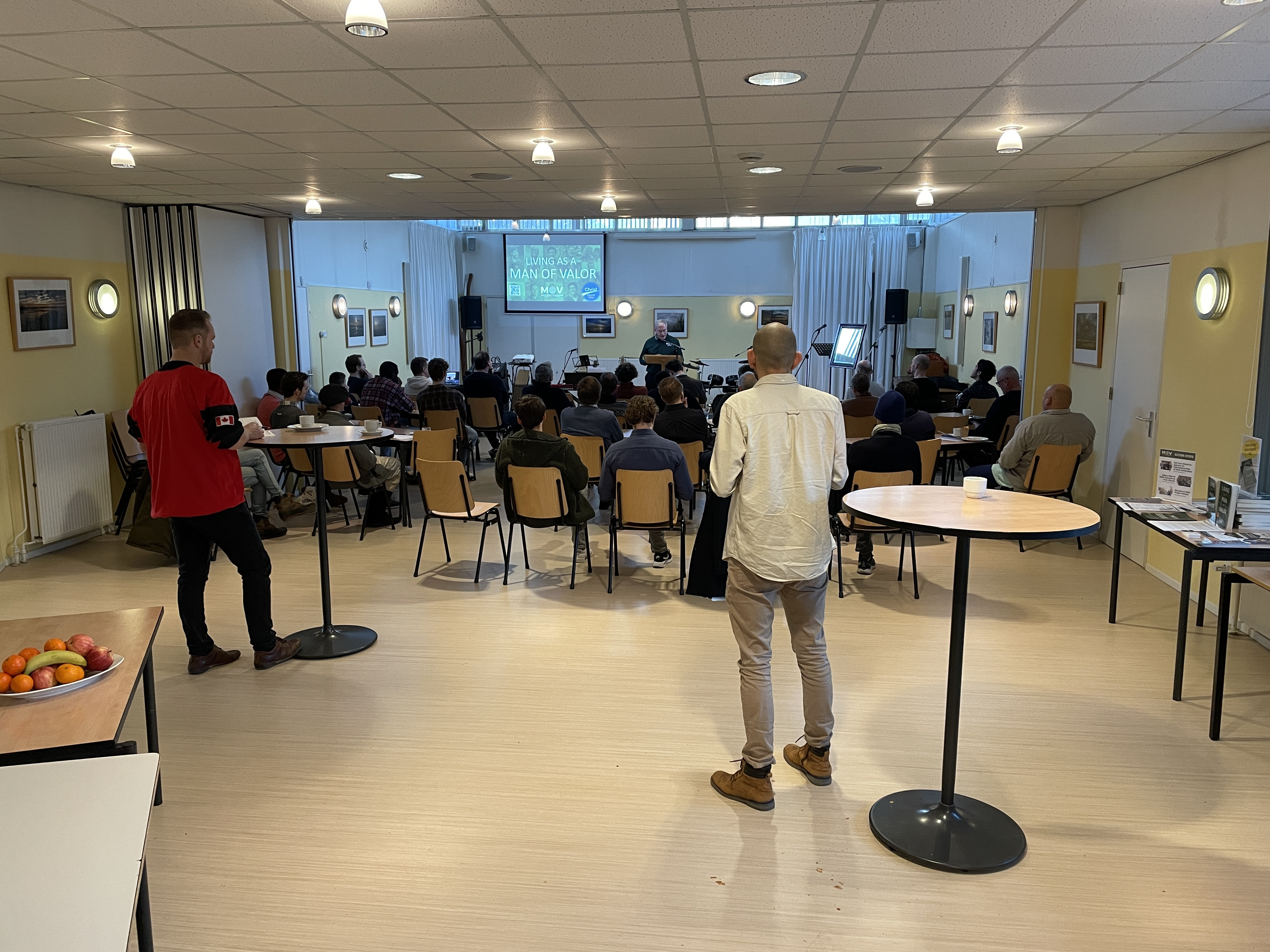
I am thrilled to share the incredible success of our recent Men’s Day event, held on January 11 at Christ Church, Heiloo. This truly uplifting day brought together 34 men – including two guests who were not believers – for a time of fellowship, worship, and personal growth.
 
Our featured speaker, Brad Smith, guided us through the inspiring Men of Valor material (see https://www.menofvalor.org/), challenging and equipping us to embrace our identity in Christ. Brad encouraged the group to reject the often-negative messages of secular culture and social media, instead believing the truth of Scripture about how God sees us. His heartfelt teaching reminded us that we are called to live as men of courage, integrity, and faith.

A Day of Worship and Fellowship
The day began with a hearty breakfast, setting the tone for an atmosphere of camaraderie and openness. Following this, we experienced a historic moment for Christ Church: our first-ever live worship team led us in heartfelt praise and worship, albeit with a few hiccups. The sound of voices lifted together in song was both powerful and humbling, uniting us in spirit and purpose. (https://www.youtube.com/watch?v=Dx4TvGRn2cs)

Brad’s message also called us to action. Each participant was encouraged to build intentional friendships with other men, creating a network of mutual support and encouragement to deepen our walk with Christ. These connections are the foundation of the vibrant and devout community we strive to cultivate. The event concluded with a delicious hotdog lunch, providing more time for conversation and reflection.

Looking Ahead to April 5 with Phil Knox
This Men’s Day was our most impactful event yet, and we’re excited to build on this momentum! Our next gathering will take place on April 5, featuring Phil Knox from the Evangelical Alliance (see https://www.eauk.org/author/phil-knox). Known for his passion for storytelling, evangelism, and friendship building Phil will inspire us to grow in faith and share the hope of Christ with those around us.

Also Looking Ahead to May 17 with Jo Frost

We are all looking forward to this year’s Women’s Retreat with Jo Frost, also from the Evangelical Alliance (see https://www.eauk.org/author/jo-frost). Jo is married to Andy Frost who was our Men’s Day speaker last year. Last year we had over 100 women sign up (many of whom were seekers) for this day of encouragement and enjoyment…who knows what our Lord will do this year!

Thank You for Your Support
We are so grateful to everyone who made this day possible – our volunteers, worship team, and, of course, our supporters. Your prayers, encouragement, and financial gifts are vital to events like these. All our outreach events are free to all participants to encourage maximum attendance and so we simply cannot do this without you!

As we plan future Men’s Days, Women’s Retreats, Outreaches to Children, our regular services, and other ministry initiatives, we humbly ask for your continued support. If you feel led to partner with us, whether through prayer, time, or resources, please reach out to us! You can find us here on the SAMS-USA website under the "Meet our Missionaries" button: 
https://give.samsusa.org/missionary/johann-and-louise-vanderbijl 

And please visit Christ Church, Heiloo’s new website: https://christchurchheiloo.nl/ 

Let’s continue to encourage one another and grow in faith as we walk together as followers of the one who makes us men and women of valor.

Blessings, love, and hugs
Johann and Louise
Facebook
Website
Email
Twitter
Support Us
Johann and Louise spent two years helping to develop the St. Frumentius Seminary in Gambella, Ethiopia. They then worked in Southern Africa, serving in seven southern African countries, while continuing to work with the Diocese of Egypt, North Africa through engaging in a disciple making movement in order to grow the body of Christ. They are now serving in Heiloo, the Netherlands.
We are sent  through the Society of Anglican Missionaries and Senders, a missionary sending community, engaging in building relationships with the worldwide church to experience the broken restored, the wounded healed, the hungry fed, and the lost found through the love and power of Jesus Christ. 
Support SAMS
Copyright © 2016 Society of Anglican Missionaries and Senders, All rights reserved.
www.sams-usa.org
    

Our mailing address is:
PO Box 399 Ambridge PA 15003
Attention to: Johann and Louise van der Bijl

Want to change how you receive these emails?
You can update your preferences or unsubscribe from this list


This email was sent to Vanderbijl@gmail.com
why did I get this?    unsubscribe from this list    update subscription preferences
SAMS-USA · PO Box 399 · Ambridge, PA 15003-0399 · USA

Email Marketing Powered by Mailchimp

Thursday, January 16, 2025

All Age Service Talk: The Father of the Prodigal Sons and the Three Types of Board Game Players

Psalm 1                      Luke 15:1-32

Talk: The Father of the Prodigal Sons and the Three Types of Board Game Players


Who here likes playing board games? 

Now, with board games there are always three types of players…and likewise, in life, there are also always three types of people.


1. The Loving Player

The first player wants everyone to enjoy their time together as one happy group. For them, the main objective is joyful connection with their family or their friends. Winning or losing isn’t the point. They play for the fellowship.

This player is like the Father in the parable. When the younger son squanders everything and returns home, the Father’s concern isn’t about rules, regulations, or revenge, but rather about restoration, reconciliation, and celebration. 

His joy lies in being reunited with his child. Like the Loving Player, the Father shows us that the greatest prize is not strict adherence to ritual or systems, but love and relationship.


2. The Rule-Breaker to Win

Next, we have the one who plays to win—at any cost. They bend or break the rules, focusing only on their gain, even if it ruins the game for others. This is the younger son. He walked away from his family, taking his inheritance and wasting it. In life, he “broke the rules,” living recklessly for personal pleasure. 

He was like the man who walked in the counsel of the wicked, stood in the way of sinners, and who sat in the seat of scoffers. In Jesus’ day, these were the people the religious leaders called ‘sinners’ (Luke 15:1). 

In our parable, when the younger son realised his error and was sorry for it, his Father welcomed him back without hesitation or condemnation. Just like Jesus welcomed and had meals with ‘sinners’.

The Father didn’t shame the younger son for “breaking the rules”; instead, He prioritized grace over judgment. This should remind us that even when we fail or go astray, God’s love is waiting to restore us when we return to Him.


3. The Rule-Enforcer

Finally, there’s the player who won’t participate unless every rule – at least as they understand the rules – is strictly followed. 

For them, correctness is everything. But their rigidity can sometimes steal the joy of the game. These are the players that say, “It’s my way or no way!” “Either you play by my rules, or I’m not playing…I’m leaving!”

This is the older brother in the parable. These were the religious rulers of Jesus’ day. Just like the older brother they could not  celebrate the younger brother’s return because it felt unfair. This is the person who thinks, “I’ve played by the rules, and I am right and they are wrong.” 

The older brother’s attitude reflects how easy it is to value rules over relationships. But the Father still gently invited him to join the supper. The Father shows us that mercy, love, and kindness…not strict adherence to rules or the interpretation of rules…is what creates a truly joyful “game” of life.


In this story, the Father is the ultimate board game host. He knows the rules but values connection over competition. He loves his children equally—whether they’re the fun-loving, rule-breaking, or rule-enforcing type. He invites everyone to the table, reminding us that life isn’t about “winning” but about being together.

Whether we’ve wandered off like the younger son, rigidly followed the rules like the older son, or been somewhere in between, God’s love and mercy is there for us all. He invites us to embrace his joy and extend it to others, creating a community built on grace, not just regulations. 

So, let’s approach life not as a competition but as an opportunity to reflect God’s love and build meaningful relationships.

Wednesday, January 1, 2025

Greater Glory

Psalm 132:1-10                 Haggai 2:1-9                   Luke 2:36-40

Greater Glory

Rebuilding any kind of ruin is always a difficult task regardless of whether it is the rebuilding of a war-ravaged country, rebuilding a damaged building, or rebuilding the lives of people who have been shattered by some or other traumatic event. There are always so many factors to consider as one proceeds. Such as, realistically assessing the extent of the damage, clearing the rubble, testing the remaining structures for soundness, deciding on what remains and what must be removed for the sake of safety, deciding whether to rebuild in the same old style or to build something radically different, and then drawing up new plans etc. All these factors apply to the process of rebuilding, whether that rebuilding be physical, emotional, or spiritual.

The word of the Lord recorded in our Old Testament lesson came approximately one month after the difficult task of restarting the rebuilding process of the ruined temple. Extensive renovations had already been made on the city of Jerusalem during dangerous and difficult times. The endurance level of even the most enthusiastic had no doubt been taxed to the limit, and the need for some encouragement was great. 

During the seventh month, the time when the prophet received this word from the Lord, progress had been delayed by the major feasts and sabbaths on which no work was allowed to be done. The first day of that month was the Feast of Trumpets, the tenth day the Day of Atonement, and on the fifteenth day the Feast of Tabernacles started during which the entire population moved out of their homes and into makeshift leafy shelters as a reminder of their Exodus wanderings. It was also a time when the people celebrated the harvest, giving thanks to God for his bountiful provision. As such, this was a time for reflection as well as rejoicing, but it was also a time of delay, and one can only imagine how the patience of those who wanted to move forward was being tested. 

On the final day of the Feast of Tabernacles, twenty-one days later, Haggai the prophet was instructed by God to speak encouraging words to the governor and the high priest as well as the small group of returnees. Those who remembered the previous temple of Solomon before its destruction by the Babylonian forces, more than likely often spoke of its former beauty and grandeur, perhaps even offering unwanted pessimistic comments of how impossible it would be to recapture that past glory. Those were the post-glory days…

All too often disappointments in the past cast a shadow of doubt over present and future hope…and, in this case, there were many reasons to be negative. It didn’t take much to make an unfavourable comparison between their past and their present. Solomon’s kingdom had been one of the wealthiest at the time, but all that had changed. These few returnees from exile in Babylon did not have those kinds of resources available, other than what had been given to them when they left their place of captivity. They couldn’t pay skilled contractors or import luxury goods or duplicate the costly furnishings and accessories. 

If anything was to be done, they had to do it themselves with the little they had at their disposal. The delays, the lack of skilled labour, the lack of adequate funds, tools, and resources, as well as the nagging negative comparisons had begun to erode their incentive to persevere. One can only imagine what kinds of conversations took place. 

As the younger generation skimped and saved simply to get by, the impoverished older generation looked on and said: “Do you call that a Temple? That’s not a Temple. This,” at which point they pulled out a BC equivalent of polaroid photographs of Solomon’s Temple, “This is a Temple.”

“Look,” fumed a frustrated and fatigued farmer acting as a stonemason, “I’ve been working my hand raw on making stones for this building. If you can do better, be my guest. I can’t help it if we have no funds, no proper tools, and a limited work force. I’m doing the best I can.”

The older generation sighed and shed a few tears as they remembered the good old days. “Ah, the gold of the Temple shone like the sun. Ah, the carvings and the curtains and the vestments and…” Well, I’m sure you’ve got the picture.

Enter Haggai the Prophet. Turning first to the older folk he said, “Who is left among you who saw this Temple in its former glory?” A few gnarled hands were raised. “And how do you see it now?” Quivering lips opened and shut without making a sound. “In comparison with it, is this not in your eyes as nothing?”

“Now, wait a cotton-picking minute, Haggai, that’s not very encouraging,” the sweating farmer acting as a stonemason starts to say, but before he can utter another syllable, Haggai booms out enthusiastically. “Yet now be strong…and work! I am with you,” says the Lord of Hosts. Now, if this were a movie, a rising swell of dramatic orchestral music would be growing stronger as Haggai begins to pace up and down. Or if Netflix was involved, he would be on horseback galloping back and forth before a mass of cheering people as the camera-drone whirls around him in ever-widening circles. Prophetic theatre even Joel Osteen couldn’t beat. 

“Be strong,” was a command repeated many times during Israel’s chequered history, but in this particular case, the words evoked images of the Exodus and the Conquest. “I am with you…according to the covenant that I made with you when you came out of Egypt. My Spirit remains in your midst. Fear not!” There is a striking resemblance between these words and those spoken by Jesus in Mark 6:50 as he walked towards the terrified disciples on the Sea of Galilee. “Take heart;” he said. “It is I. Do not be afraid.” Also, his final words spoken prior to his ascension: “Make disciples of all nations wherever you go – I am with you, even to the end of the age.” (Matthew 28:18-20) You see, the personal presence of the Lord himself, bolsters courage and rekindles determination as we realise that the Almighty Creator, by whose will all things exist and continues to exist, is not only with us, but he is also well able to bring to completion whatever he has begun. 

The destruction of Jerusalem and the Temple by the Babylonians and the ensuing 60-70 years of exile was fertile soil for seeds of doubt and despair. But here through the words of the prophet Haggai, the Lord reaffirmed his faithfulness to the very same covenant he had made with them when he delivered them from bondage in Egypt. As he was with them then, he was with them now. His cause would not fail despite their faults, their failures, and their frailty. 

“Yet once more,” said the Lord, “in a little while, I will shake the heavens and the earth and the sea and the dry land. And I will shake all nations, so that the treasures of all nations shall come in, and I will fill this house with glory...” The image of the convulsing of the universe is a common one in the prophets usually indicating political upheaval and the collapse of principal powers or even empires…NOT to be taken literally, if you please, as others have done in the not-so-distant past. 

But while it is difficult to say what Haggai would have thought about as he spoke these words, if we compare Scripture with Scripture, the Lord was more than likely referring to the coming of the one who would shatter human kingdoms to set up an eternal kingdom that would fill the whole earth (Daniel 2:37-45; 7:13-20), through which all the nations of the earth would be blessed in keeping with the promise God had made to Abraham concerning his descendants (Genesis 12:1-3). 

At that time, the treasures of the incoming Gentile nations would serve to beautify a non-geographical, spiritual, and heavenly Temple until it becomes a spectacular edifice filled with a splendour far greater than anything Haggai or his listeners would have been able to comprehend. God is never short on funds because he is the owner of all things. The silver and gold is his and he will dispense with what is his whenever and to whomever he sees fit. 

Which reminds me of the scene in Fiddler on the Roof where Tevye is discussing wealth and poverty with Perchik, the man who would later become his son-in-law. “Money is the world’s curse,” Perchik says. To which Tevye responds, “May the Lord smite me with it! And may I never recover!”

Be that as it may, it is interesting to note that shortly after Haggai spoke these words, his prophecy was, in fact, partially fulfilled in a way few would have thought possible. According to Ezra 6:8-12, those who had initially opposed the rebuilding of the Temple and who had tried unsuccessfully to bring the work to a halt, were ordered by the Persian monarch to not only desist in their attempt to stall the labour, but to also cover the cost of the builders in full and without delay from the royal revenue. And whatever was needed was to be supplied…bulls, rams, sheep, wheat, salt, wine, or oil. And then, later Herod, the unpopular Edomite King of the Jews, built a Temple that quite literally surpassed the glory of the Temple of Solomon.

Yet I believe this prophecy was primarily fulfilled in the coming of one greater than the Temple (Matthew 12:6) who supplanted it (John 2:13-22). At that time the promise of peace was fulfilled outside the walls of the city of peace by the Prince of Peace himself, and that peace was taken into the whole world by the Israel of God, restored and rebuilt with the old (the Jews) and the new (the Gentiles) through the power of the Holy Spirit. 

The prophecies of Ezekiel foretold that healing waters would flow from the threshold of the renewed Temple (Ezekiel 47:1). Jesus said that out of him would flow rivers of living water (John 7:38). It is little wonder then that John described the establishment of God’s reign over all the earth in terms of a River flowing from the throne of God and of the Lamb through the midst of the Tree of Life whose leaves bring healing to the nations (Revelation 21:22; 22:1ff).

Ultimately, the prophecy of Haggai, although fulfilled temporally and temporarily at the time of the Restoration and later under Herod, the prophecy of Haggai was primarily and finally fulfilled in the Word made flesh who came to Tabernacle among us (John 1:14) and whose glory, the glory as of the only begotten of the Father, full of grace and truth, was seen by all who beheld him then and all who behold him now, crowned with glory and honour and seated at the right hand of God. As the Israel of God (Galatians 6:16; 3:28-29; Romans 9:6-8) and as the New Jerusalem (Hebrews 12:22-24), the Church is filled with the glory of the Lord God Almighty and the Lamb radiating from the New Temple (Revelation 21:22).

Haggai’s stirring prophetic words were intended to empower and galvanise a demoralised people into completing a project that seemed impossible. His call was for a renewed focus on the one who was with them just as he had been with their forefathers when they had faced the impossible. This was a call for renewed faith in the Lord, renewed holiness of life, renewed courage, and a renewed vision. They were not to despise the day of small beginnings, but to press on, ever anticipating God’s timely intervention. 

I don’t think I need to remind you of the sad state of the Church in North Holland. Like the remnant in Haggai’s day, we too may be tempted to despair when we look at what the Church had been just a few generations ago. We too may shed tears with the older folk who remember the glory of those days or sigh with the younger folk who struggle to rebuild against all odds. But the same God who was with them is with us and he speaks the same words now as he did then. “Yet now be strong…and work! I am with you,” says the Lord of Hosts. “Do not fear, for my Spirit remains in your midst. Fear not.”

Shall we pray?

© Johannes W H van der Bijl 2025
Monday, December 23, 2024

The Man Christ Jesus

Philippians 4:4-9                      John 1:19-28

The Man Christ Jesus

Anyone who seriously attempts to study first-century history cannot avoid grappling with the question of Jesus and his followers. While they might believe the evidence is too sparse to draw significant conclusions, or they might worry about theological implications, or suspect there’s little new information to uncover, the question remains: why did this particular group – the followers of Jesus – why did they, among countless others of the time…why did they evolve so uniquely, crossing national boundaries, transcending cultural differences, and demolishing class distinctions…and why did they grow so quickly?

Why did early Christianity spread so rapidly and so widely, embracing people from radically different backgrounds and customs and belief systems and practices? When we seek to answer these types of questions genuinely and honestly, we find that their ethos as well as their explosive expansion had very little to do with structure, schemes, or strategy. Rather, it had something to do with the uniqueness of one single Person, the Man Christ Jesus. 

The Early Christians believed that what had been revealed to them was true and consequently true for everyone. Pagan authors at the time wrote about Christianity spreading swiftly like a poison despite harsh resistance and persecution. So, one might well ask, why would men, women, and children risk everything to engage in mission? What was the reason that Christianity spread so rapidly throughout the known world from a tiny country in the Middle East? I believe the answer is quite simple. To the early believers, what they communicated was far more than a simple new existential self-improvement religion. No, to them the act of telling others about their faith was not about anything other than this Divine Person whose incarnation we celebrate during the Christmas season. They did what they did because of what they believed about Jesus.

Jesus was fundamentally different from the leaders of the other groups and his teachings had fundamentally different aims and therefore fundamentally different results. He was a controversial figure right from the start, deliberately avoiding celebrity status, revelling in humble self-sacrificial service, deflecting any glory, and obediently following the will of his Father, even to the point of death on the cross. The many messiahs before him were all political or military revolutionaries and zealots who sought to reestablish the ethnic and geographic kingdom of Israel through violent insurrection. 

So, you can imagine how the messianic expectation, reignited by the preaching of John the Baptist, and the messianic reality, as Jesus’ ministry unfolded must have puzzled many. Speculations and anticipations multiplied as John announced that the Kingdom of God was at hand. It is no wonder the authorities in Jerusalem sent delegates to enquire as to his identity. Was he just another rabble-rouser, or a crackpot, or could he possibly be the one they had all been waiting for? The latter would have been a terrifying prospect for those who owed their prosperity to collaboration with the hated Roman oppressors. 

To us, John’s replies appear to be maddeningly mysterious, but the typical rabbinical teaching method at the time was to answer questions with answers that would provoke more questions and so on until the questioner arrived at the desired conclusion. Because John did not wish to muddy the waters for the as yet undisclosed messiah, he categorically denied that he was the Christ. It is imperative for any messenger or ambassador to clarify his position. We too must remember that as ambassadors of Jesus, we are to represent him not our own opinions…we must be weary of exclusively basing our message on any interpretation of his Word. While it is not wrong to quote scholars, reformers, theologians, great preachers, sermons, confessions, or declarations, we must remember that the Word of God alone is divinely inspired and therefore we must always hold human interpretation or tradition lightly and keep them accountable to the Scriptures. 

Of course, John’s denial that he was the messiah raised more questions and so the delegation turned to the next possible candidate – Elijah. You may remember, the prophet Malachi had stated that God would send the prophet Elijah before the coming of the great and dreadful day of the Lord…but John once again denied the identification. “I am not Elijah,” he said. 

But John’s denial here has often confused readers of the Gospels simply because Jesus later affirmed that he was, in fact, Elijah (Matthew 17:10-12). The interesting thing about Jesus’ statement is that it was spoken shortly after the transfiguration where both Moses and Elijah appeared to Jesus and conversed with Jesus, clearly indicating that Jesus knew full well that Elijah and John were two different people. So, it seems that what John was denying was that he was Elijah himself…in other words, he was saying that he was not a reincarnated or resurrected Elijah. And in that sense, what Jesus was affirming then, was that John had come in the ‘spirit and power of Elijah” (Luke 1:17). 

You see, as a prophet, John served as a herald announcing that what the Law and the Prophets pointed forward to was about to be fulfilled. In many ways, he was the bridge between the Testaments, between shadow and reality, promise and fulfilment. And as such he was Elijah, but in a prophetic sense, not in a literal sense, the latter possibly being what the delegation had in mind when they asked the question.

Their next question referenced an enigmatic figure mentioned by Moses in Deuteronomy 18:15-19. “The Lord said to me, “Moses told the people, “I will raise up for them a Prophet like you from among their brethren, and will put my words in his mouth, and he shall speak to them all that I command him. And it shall be that whoever does not hear his words, which he speaks in my name, I will require it of him.”

Now, if you know the Gospels well, you would have recognised words and statements Jesus used from this passage in reference to himself. You see, as a human, he was a Jew raised up from among his brethren. However, as God incarnate, he spoke only that which the Father told him to speak (John 8:47; 12:49-50). Nevertheless, that this Prophet was considered to be the messiah by the Early Church seems clear from passages such as Acts 2:22-26 and 7:37…but because 1 Maccabees 14:41 (an historical, post-independence, Hasmonean apocryphal book from the Hellenistic Period) indicated that the messiah and this prophet were two separate offices, the delegation from Jerusalem might have been confused. Either way, John claimed that he was neither.

Exasperated, the delegation then asked him to give them something to take back to those who had sent them. In reply, John quoted Scripture: “I am the voice of one crying in the wilderness: make straight the way of the Lord.” This prophesy from Isaiah 40 ought to have brought the delegation to their knees because the chapter is filled with direct references to the coming of God himself, but, sadly, it seems as if they were either unwilling or unable to make this connection. 

Their primary objection, remember, had to do with authority. If John was not one of the three exalted persons mentioned before, well then by whose authority was he calling Jews to repentance, and by whose authority was he baptising them? Remember, baptism was an Old Testament cleansing ritual usually performed by a priest to prepare them to meet with God – something first done at the foot of Mount Sinai (Exodus 19:10-11). Clearly, as a priest, he had not been sanctioned by the priesthood. 

(See also, Exodus 30:17-21; Leviticus 11:24-28; 14:8-9; 15:5-13; 16:4, 24; Numbers 19:11-22; Deuteronomy 23:10-11; Psalm 51:2,7; Isaiah 1:16-18; Ezekiel 36:25-27; Zechariah 13:1; Matthew 3:11; Ephesians 5:26; Hebrews 10:22. Interestingly the Hebrew word “mikvah”, a cleansing baptismal ritual in Jewish tradition, is used first in Genesis 1:10, where it refers to the dry land emerging from the primeval waters.)

Now, this question of authority later became an issue for the Jewish leaders in their rejection of the ministry of Jesus as well. The crowds marvelled that Jesus spoke as one with authority rather than one under authority. Such a person either spoke as an individual which would render his witness suspect, or he was directly sanctioned to speak by God himself, a conclusion the Jewish leaders could not bring themselves to accept. 

But neither John nor his greater cousin, Jesus, needed human endorsement or approval. In both cases, their authority and the exercise of their respective ministries were backed up by the Scriptures, and, as such, both were authorised by God. John was the forerunner, the messenger, the herald. Jesus was the fulfilment of prophecy, the long-awaited Messiah. And so, neither John nor Jesus needed to defend their claims nor were they answerable to anyone with regard to their authority. 

From the beginning, John claimed to be only what he was…a voice, no more, but no less. A voice heralding the coming of the King and his Kingdom…the arrival of God himself as foretold by the Law and the Prophets. Right from the start his focus was on Jesus and therefore his message remained centred and singular despite challenges and adversity. 

The same was true for the early Christians. They were voices…messengers…witnesses to Jesus. No more, but certainly no less. Likewise, with us today. This same undiluted message, when delivered without addition or embellishment, still brings peace to the hearts of those who focus on the Person of Jesus. If we, like John and like the Early Church remain fixed on him in our proclamation, then what happened in the first century can and will happen again.

The person of Jesus is as controversial today as it was before, during, and after John the Baptist’s ministry. The exclusive claim of Jesus is an affront to our modern pluralistic society just as it was in the pluralistic society of the ancient world. But we have a message which must not be changed to seek the world’s endorsement or approval. 

Jesus remains the one and only universal King. Denial, dismissal, or denunciation does not change the truth. Unlike the other religious groups and movements throughout the centuries, the message of Jesus continues to break down barriers, promote peace, unify the divided, and expand his kingdom through the faithful witness of the Church. Why does Christianity continue to spread so widely despite attempts to ridicule or eradicate it? I believe that the answer has very little to do with structure, schemes, or strategy. Rather, it has something to do with the uniqueness of one single Person, the Man Christ Jesus. 

Shall we pray?

© Johannes W H van der Bijl 2024

Thursday, December 19, 2024

A Special Christmas Tale

The Nativity Story: A Special Christmas Tale

I think you all know the story about the very first Christmas. Some people call it the Nativity (from the late Latin word meaning ‘birth’), because it’s all about the birth of someone very, very special: Jesus.

Now, we’ve already heard how Jesus’ birth was foretold by the prophets in the Old Testament era, but I’d like us to jump on in the middle and start our journey in a small town called Nazareth. 

There lived a young woman named Mary who was engaged to a man by the name of Joseph. One day, an angel named Gabriel appeared to Mary. Can you imagine how surprised she must have been? The angel
told her, “Don’t be afraid, Mary. God has chosen you to have a very special baby, and you will call him Jesus. He will be the Son of God.”

Mary trusted God and said, “I am God’s servant. Let it be as you have said.” What amazing faith Mary had!

Some time later, Mary and her husband, Joseph, had to take a long journey from Nazareth to a town called Bethlehem. They had to go because the ruler of the land wanted to count all the people in his kingdom and Joseph was a direct descent of King David and that family was originally from Bethlehem. Mary was expecting her baby very soon, but they had no choice but to travel. Can you imagine walking so far (or perhaps riding on a donkey) when you’re about to have a baby? Either way, it must have been very hard for Mary!

When they finally got to Bethlehem, the family home was already so crowded with other family members that there was no room for them to stay in the upper room usually reserved for guests. So they had to stay on the ground floor with the owners and their animals. Those days people kept their animals inside their homes in a separate section. It wasn’t fancy, but it was a warm and safe place for Mary to have her baby.


That night, something wonderful happened. Mary gave birth to baby Jesus! She wrapped him in strips of cloth to keep him warm (perhaps the same strips of cloth the shepherds used to protect newborn lambs from injury so that they would be without blemish for the sacrifices) and laid him in a manger, which is a feeding trough for animals, usually made of stone in those days.

That humble home in Bethlehem became the place where the Saviour of the world was born.

Not far from Bethlehem, some shepherds were in the fields taking care of their sheep. Suddenly, an angel appeared in the sky. The shepherds were scared at first, but the angel said, “Don’t be afraid! I bring you good news that will bring great joy to all people. Today, in Bethlehem, a Saviour has been born. He is Christ the Lord!”

Then, the sky was filled with more angels, all praising God and saying, “Glory to God in the highest, and on earth peace to those on whom His favour rests.”

The shepherds were so excited! They hurried to Bethlehem to see this special baby. When they found Jesus lying in the manger, just as the angel had said, they were filled with joy. But can you imagine what they must have thought when they saw the baby wrapped in the strips of cloth they usually used to protect the sacrificial lambs from injury? They later told everyone they met about what they had seen and heard.

A while later, far away in the East, some wise men saw a bright star in the sky. They knew it was a sign that a new king had been born, no doubt because they had been told about the prophecy in the book of Numbers by Daniel who had been appointed as head of the wise men in Babylon so many years before. They followed the star all the way to Bethlehem, bringing gifts for baby Jesus: gold, frankincense, and myrrh. These were treasures fit for a king.

When the wise men saw Jesus, they bowed down and worshipped Him. They knew He wasn’t just any baby – He was the Saviour God had promised to send – and so they returned to their home rejoicing.

But the story of the Nativity is not just a story about a baby being born; it’s about God’s love for all of us. Jesus came to bring peace, hope, and joy to the world. That’s why we celebrate Christmas – because it reminds us of the greatest gift ever given: God’s Son.


So, when you see a Nativity scene with Mary, Joseph, baby Jesus, the shepherds, and the wise men, remember the story we shared today. And remember that Christmas is all about love, kindness, and giving, just like God gave us His Son.

Merry Christmas and may God bless us, everyone!


© Johannes W H van der Bijl 2024