Saturday, March 23, 2024

Follow the Signs

Exodus 12:3, 5a, 7, 12-13                     Zechariah 9:9-10                        Matthew 21:1-11     

Follow the Signs

Can anyone tell me what is special about today? Yes, it is Palm Sunday. 
That’s a funny name for a day, don’t you think?
Why do you think we call it Palm Sunday?

The Bible often uses pictures to describe things we might not always understand. 
And often those pictures are meant to be signs pointing us in the right direction.

In the passages we read from today, the book of Exodus, the book of the prophet Zechariah, and the Gospel according to Matthew, we find a beautiful picture full of signs pointing to the Messiahship of Jesus.

So, let’s go through some of the signs that helped the people understand that Jesus was their promised King and Saviour…and let’s see if these signs can help us understand more about too, shall we?
SIGN 1: 

 
Our first sign is the humble donkey mentioned in Matthew 21:1-11. 
How was the donkey a sign for the people?
Yes, by entering Jerusalem on a donkey, the people realised that Jesus was fulfilling the prophecy of Zechariah 9:9-10. 

But this sign was a bit of a problem.
Does anyone know why?
Yes, the people had been taught that the Messiah would be a warrior like Joshua or a conquering king like David.

SIGN 2: 


By riding into Jerusalem on a donkey, Jesus was telling them that he was not coming as a conquering political warrior on a big horse like the leaders of the day, but as a humble and gentle king, symbolising his message of peace and humility.

You see, Jesus is our King, but not in the earthly sense of power and authority. Jesus came to save us from the power of sin and death. He came to conquer the devil and every evil thing.

But how could Jesus conquer sin and death and the devil?
To answer that question, we need to go back to the sign we read about in Exodus.
Can anyone remember what that sign was?

SIGN 3:


The Passover Lamb, yes.
Can anyone tell me what the Israelites were told to do?
Yes, they had to sacrifice a perfect lamb and spread its blood on their doorposts.
What a funny thing to do! Why did they have to smear the blood of the lamb on the doorposts? 
It was a sign…but what was it for?
For protection, yes! When the angel of death saw the sign then he would pass over the house and move on elsewhere.
In the very same way, Jesus, the perfect Lamb of God, offered himself as the ultimate sacrifice for our sins, his blood serving as a sign to mark us as redeemed and saved.

But how was Jesus offered up like the Passover Lamb? 
SIGN 4: 

Yes, Jesus died for our sins on the cross.
Did he just die for our sins on the cross or did he do something more?
Yes, Paul tells us in Colossians that Jesus cancelled our sins on the cross, but that he also defeated and disarmed the devil and his evil angels. 
So, in that sense, Jesus was a warrior king, wasn’t he? 

But I want you to think about what the sign of the cross means for us today.
The Apostle John tells us that what Jesus did on the cross for us shows how much God loves us!
So, for us, the cross is a sign that God loves us so much that he was willing to be our Passover Lamb…dying for us so that we might be protected and delivered.

But do you think that’s what the disciples understood on that awful day when Jesus was arrested, tried, and executed on the cross?
No, I think they didn’t understand the sign of the cross at all.
What do you think they thought as they stood watching Jesus die on the cross?
They thought it was all over, didn’t they? That this was the end.
They thought they had been following the wrong man…that Jesus wasn’t the Messiah after all.

But they were misunderstanding the sign, weren’t they?
SIGN 5:
 
They thought that when Jesus died on the cross everything, they believed in was not true.
They thought they had been mistaken all along.
And now they were scared and they felt very alone.

Have you ever felt that way?
That everything was going wrong?
That nothing was working out the way you thought it should?
How did you feel then?
Did you feel alone? Did you feel frightened?

But we know that the cross was not the end, don’t we?
How do we know that?
Yes, because Jesus gave us another sign, didn’t he?

SIGN 6:


Yes, Jesus gave us the sign of an empty tomb. 
What does that mean?
Yes, Jesus is not dead anymore! 
The Bible tells us that on the third day, he rose triumphantly from the grave!
But that is the story for next Sunday…

So, what have we learned about signs today?
Signs point us in the way we should go.
Signs point us to Jesus.
But are we always right in the way we understand signs? 
Not always… that's why we need to take all the signs and put them together like one big jigsaw puzzle…when we see all the signs together, then we see the picture more clearly.

So, what shall we pray for?
Ask children to pray…and then close with prayer.

Saturday, March 16, 2024

Credentials for Service

Psalm 36:5-12                      John 13:1-17

Credentials for Service

Dwight L. Moody apparently once said: “The measure of a person is not how many servants he has, but how many people he serves.”  Years ago, a friend of mine who went to seminary in Germany told me of an incident that occurred when their septic tank overflowed due to a blockage. Evidently, the person in charge of maintenance was on leave, so as a student, he reported it to the principal’s office. Later, when he returned to the men’s bathrooms, he was pleasantly surprised to see a man hard at work, ankle-deep in the sludge, unplugging the drain with his hands and then washing away the muck. His surprise, however, quickly turned to shame as he saw who it was who was cleaning up the mess. It was the principal of the seminary. 

Needless to say, my friend never forgot his lesson in humility. Now, I think that Jesus taught a similar lesson to his disciples in our Gospel passage for today.

John tells us that the incident took place the day before the Passover…in other words, the Day of Preparation on the 14th of Nissan. Scholars have struggled to correlate John’s timeframe with that of the synoptic Gospels as he seems to place the Last Supper on the evening before the actual Passover, apparently one whole day too early for the slaughtering of the lambs. However, Exodus 12:6 states that the ritual killing of the lamb could take place “between the two evenings”, in other words, sometime between the sunset that would start the Day of Preparation and the following sunset that would start the day of the Passover. 

It is also true that the Pharisees and the people from Galilee counted days from sunrise to sunrise while the Sadducees and the people of Judea counted days from sunset to sunset, so it is possible that Jesus and his Galilean disciples celebrated the Passover a day before those holding to the Judean calendar. 

Others have asserted that due to the sheer volume of pilgrims, the priests out of necessity began to slaughter the lambs a day earlier so that all could be ready for the Feast. Whatever the case may have been, all these explanations allow for Jesus to have been crucified at the same time as lambs were being slaughtered in the Temple.

According to verse one, the foot-washing incident was a direct result of Jesus knowing that his hour had now come. So, there must be some link between Jesus’ substitutionary sacrifice on the cross and this action of washing his disciples’ feet. It was because of what he knew that he now did what he did. Bear that in mind as we work our way through this passage.

Chapters 13-17 are what we would call a Farewell Discourse, very much like the latter part of Deuteronomy and other final wills and testaments found in Scripture. The most important point made throughout this discourse is Jesus’ love for his own. John tells us that his love is constant, unchanging, and permanent. His love was not based on the performance of his disciples…if it were, his love would be impossible. 

Our kind of love is so unlike our Lord’s love. Our love is very often performance-oriented, and we tend to mercilessly reject those who do not measure up to our expectations. Even our love for God tends to be subject to his performance…whether or not he has given us what we desire or what we expect him to give. As such our love for God or for others is a poor symbol of his love. As C. S. Lewis has said: “On the whole, God’s love for us is a much safer subject to think about than our love for him.” 

Never make the mistake of measuring God’s love by the actions of another human being, whether they are believers or not. God’s love cannot be fathomed or measured. As the Psalmist says: “Your steadfast love, O LORD, extends to the heavens, your faithfulness to the clouds. Your righteousness is like the mountains of God; your judgments are like the great deep; man and beast you save, O LORD. How precious is your steadfast love, O God! The children of mankind take refuge in the shadow of your wings.” (Psalms 36:5-7) God’s love for you is infinitely deeper than anything you could ever imagine.

And so we should never lose sight of Jesus’s love for us, even during our most desperate moments. His disciples were about to face the most stressful time of their lives…a time when every one of them thought God had abandoned and forsaken them. But they, like us, could not see into the future…even though he had told them repeatedly about the resurrection, their finite minds could not see beyond the cross…they could not understand that in three days the battle against Satan and sin and death would be won. 

So, don’t measure his love for you by events or by circumstances, whether good or bad. Besides, adverse circumstances are often there because of his love. So rather believe him when he says that he loves all of his own even to the very end.

The act of washing the feet of his disciples was a physical parable, a significant symbol, if you will, demonstrating the love of God revealed on the cross. There are five points in verses 2 through 5 that we need to examine to understand why Jesus washed their feet.

Firstly, we need to understand when this took place. John tells us that it happened “during supper”, not before supper. The custom at the time was for guests to have their feet washed on entry to the home by a servant, then at least one hand had to be washed for appetisers, and then both hands for the main course. Now, even though the text does not explicitly tell us that there was no one to wash their feet, it may be that as the disciples had been arguing about who was to be greatest in the kingdom before this meal (according to Luke 22:24) none of them were willing to assume the role of this foot-washing servant. Nevertheless, my point is, these washings of feet and hands usually took place before supper, not during supper.

Secondly, we need to understand whose feet were washed. John seems to indicate that all the disciples were present at this time, including Judas. So, think about this. Jesus knew that the devil had already put it in the heart of Judas to betray him and yet he still washed his feet. In fact, if any of the disciples ought to have objected to Jesus washing their feet it ought to have been Judas, not Peter! But we will look at Judas later. Let it suffice to say here that Jesus applied this sign to all his disciples to serve as both a blessing and a curse.

Thirdly, we need to understand the basis for this action. John tells us that Jesus performed this action because he knew that the Father had given all things into his hands and that he knew he would soon be returning to the Father. Verse 3 says: “Jesus, knowing that the Father had given all things into his hands and that he had come from God and was going back to God, rose from supper…he laid aside his outer garments and taking a towel tied it around his waist”…and then he washed his disciples’ feet. So, his action of foot-washing must somehow relate to this “knowing”. 

Interestingly, we see similar words used at the ascension (when Jesus was about to return to the Father) in Matthew 28:18-20. There Jesus said that all authority in both heaven and earth has been given to him. But it is the command that follows this statement that is of interest to us. Because God the Father had given Jesus supreme authority over all things and because Jesus was about to go back to the Father, he now commissioned his disciples to do to others as he had done to them…to make disciples as he had made them disciples. 

As the wording is very similar, it is possible that what Jesus did in the foot-washing incident somehow ties in with his command before his ascension…or his going back to God…especially since he commanded them after the washing to do what he had done.

Fourthly, we need to understand the role taken on by Jesus, not only here but at his incarnation. His entire life was one of sacrificial servanthood. He came to serve and to give his life as a ransom for many. If this act of foot-washing was to serve as an example to his followers, as he states it should, then anyone who claims to follow him should be like him – a servant to others. 

And then fifthly, in the light of all these previous points, we need to understand what Jesus was actually doing. Was this merely an act of hospitality overlooked by the disciples and therefore designed to embarrass them? Did it happen during the meal because Jesus was waiting patiently for someone to swallow their pride and perform the demeaning task? Or is there something more to this action?

Perhaps we should start by understanding a tradition about feet and the ground. In Genesis 3:17-19 God told Adam that the ground would be cursed because of his sin. For this reason, shoes were worn not only to protect the feet but also to prevent contact with what was considered cursed. This is why several biblical characters were told to remove their shoes when coming into the presence of God because his presence hallowed the ground on which they were standing. This is also the same imagery behind the act of shaking the dust off the feet when leaving an inhospitable village…it was a symbolic gesture that indicated that the person departing did not leave behind a blessing.

But, I think, there is an even greater meaning behind the foot-washing. In Exodus 30:17-21, God told Moses to command the priests to wash their hands and their feet before approaching the altar or before they could perform their priestly duties. Is it possible that Jesus was doing something similar here? They were about to be appointed to be disciple-makers of the nations…witnesses to Jesus’ victory on the cross…the final sacrifice on the altar, so to speak. Perhaps this is what Isaiah had in mind when he wrote, “How beautiful upon the mountains are the feet of him who brings good news, who proclaims peace, who brings glad tidings of good things, who proclaims salvation, who says to Zion, ‘your God reigns!’” (Isaiah 52:7) 

So, if we put all these images together, we see that the foot-washing event was at once a cleansing to and for service – it was a call, an equipping, a consecration, and a commissioning of the disciples to the ministry of servanthood.

As such, this act symbolised a significant heritage for the disciples…a symbol which Peter misunderstood. It has been said that the measure of a servant-like attitude is how you act when you are treated like a servant…but I think it is equally true in how you react to being served. Peter’s pride would not allow him to submit to the humble service of his Lord. Indeed, there is no parallel in ancient sources of any authority figure doing menial work like this, so one can understand his discomfort. 

Nevertheless, in my humble opinion, Jesus’ reply to Peter’s objection indicates that the washing had a deeper significance than purely customary hospitality. This is, of course, not Peter’s first objection nor will it be his last, as once again he seems to have had the wrong end of the stick, but notice what Jesus said to him. “If I do not wash you, you have no share or part with me.” He does not say Peter would have no part of him or no part in him, but no part with him. 

Why did Jesus use this preposition here? I think the answer lies in his reply to Peter’s characteristic overreaction. The washing was not a sign of regeneration – they were already proverbially ‘clean’. Rather, I think it was a sign of commissioning. Jesus declared Peter, and all the disciples except Judas, to be clean already. According to John 6:70, even before he called his disciples, Jesus knew which one would betray him. So, like the priests in the Old Testament, Peter and the others were considered clean or set apart by virtue of their position and their calling to serve. Still, their feet needed to be washed before they could serve.

To summarize: I believe that here Jesus was commissioning Peter and the others to a life of service, as followers of their servant king. This is why Jesus used the preposition with. Peter had a part with Jesus as a co-worker – as a bearer of his light, his love, and his life to a lost world. 

Now, of course, as I said earlier, if there was one who should have objected to the application of this sign, it was Judas. John tells us that he had already made up his mind to betray Jesus. So, he did have a part to play, but his role would be radically different to that of the other disciples because he had no part with Jesus. 

In verses 12-17, Jesus proceeded to reveal the significant meaning of this humble action. Even though the disciples correctly identified Jesus as Lord, they failed to understand his concept of leadership. He came to serve…to give his life as a ransom for many. That’s the credential for leadership in his kingdom. The greatest is the one who serves.

And I believe we make a big mistake if we think that it is the simple re-enacting of this foot-washing episode that Jesus wants his followers to mimic. That’s not what this is all about. Rather, it is doing whatever service is required in any given situation. 

What will destroy any church is a lack of sacrificial love for God and a lack of sacrificial love for others. Like Judas Iscariot, many in the Church throughout the ages have received the outward signs of grace while harbouring satanic tendencies in their hearts. The measure of a healthy church is not based on how many members they have, but rather on how many members use their God-given gifts for the benefit of all. 

Jesus commissioned the disciples to a ministry of service. What I have done to you, he said, you too must do to each other. This message echoes down through the centuries and applies to each successive generation. 

So, if you know these things, blessed are you if you do them.

Shall we pray?

© Johannes W H van der Bijl 2024

Friday, March 15, 2024

Interview: Johannes van der Bijl on his upcoming Narrative Commentary of Galatians

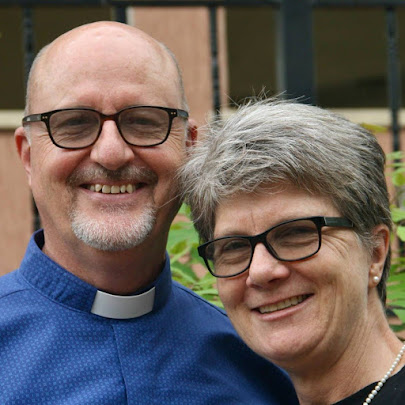
Johannes Vanderbijl is an ordained Anglican priest and SAMS Missionary serving along with his wife, Louise, in the Netherlands, at Christ Church, Heiloo. He has been earnestly writing over the last four years about the life of Simon Peter with two published books to date that have been well received: Breakfast on the Beach (Langham Publishing: 2021) and For the Life of the World (Langham Publishing: 2022)Both books focus on Peter’s ministry of making disciples using Jesus’ four-fold method of discipleship. The books are written chronologically, and Johann situates these early disciples’ lives in the real world, the day-to-day, nitty-gritty of their lived experience.
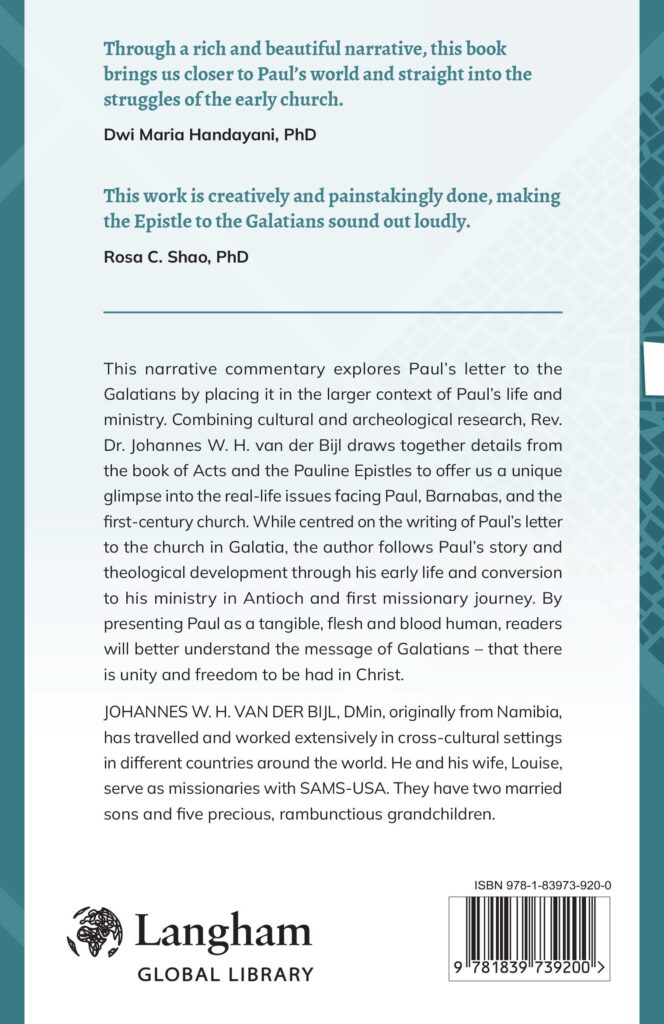
What follows is an interview with Johann Vanderbijl about his most recent book, a narrative commentary of Galatians, and how it and his other books relate to discipleship.

Johann, thank you for taking the time to discuss your upcoming book. You are focusing your first in a series of commentaries on the Apostle Paul and his Letter to the Galatians, but you have written it in a narrative style. Why did you choose to start with Galatians, and why a narrative style?

After writing in a narrative style about Simon Peter in my first two books, Langham asked if I would consider writing about Paul in the same manner. I’ll be honest – I’ve struggled with Paul all my life. I saw Paul as the John Wayne of the New Testament: a tough guy who never does anything wrong, a ‘cowboys-don’t-cry’ kind of person, whereas Peter was far more relatable to me—more expressive and emotional—hence why I felt I could write about Peter.

So, I thought, how am I going to approach this with Paul? As I was contemplating and praying, I had the idea: why not tell Paul’s story using his letters chronologically? Thus, I draw from what we are told about Paul in Acts and elsewhere, using anything that could describe Paul at that moment. I incorporate elements from his other epistles and utilize his own language as I compose these books. This volume is the first in a series of commentaries, and Galatians was his initial letter; hence, I chose to start with Galatians.

One aspect of my approach is to portray Paul’s childhood, drawing partly from speculation based on some of his previous statements—that he hailed from a family of Pharisees, came from Tarsus, and was taught by Gamaliel, etc. I piece these details together in a conversational form. Sometimes, for example, he converses with Barnabas, while at other times, I incorporate the leaders of the church in Antioch because they were sent out by the Church there. Therefore, the leaders respond to the news they received from the Galatians about the Jewish Christians who had gone there, demanding that they become Jews before becoming Christians. All of this is presented in a conversational style.

What were some of your key takeaways of Galatians?

I am currently writing on First and Second Thessalonians, which have more of a typical Greek style and structure, whereas Galatians feels like an explosion. It reads like a massive rant; Paul hardly greets them before exclaiming, ‘You foolish Galatians, who has bewitched you?!’ You can sense the emotion, making it a tough book to start with.

I also found that some parts of Galatians don’t flow smoothly because Paul jumps around in his writing. Consequently, I felt the need to fill in some gaps by explaining what he was saying, especially when there was an Old Testament background. In those instances, I would have another character say, “In other words, you are saying…” This approach mirrors other commentaries where a narrator would clarify statements. Since this is a narrative commentary, another character addresses Paul’s statements, shaping how I write it.

As I mentioned before, I always saw Paul as a kind of John Wayne, a super-masculine character. However, I’ve changed my perspective. While I still see him as masculine, of course, I now perceive a lot more emotion from him, especially as I read his other letters. He weeps over those who do not believe, he struggles and longs for Timothy and the Thessalonians. So, my opinion of him has evolved; I now see a much more tender side to this man. The anger he exhibits in Galatians stems from genuine concern for them. It’s essential to remember that Paul was an ancient Middle Eastern man who expressed emotions like rejoicing, and I try to reflect that cultural context appropriately in certain points of the letter.

A narrative style seems very accessible to everyday Christians. Did you have them in mind when you wrote this commentary?

The interesting thing is that when I began writing this, I had oral learners in mind. I thought of places like Gambela (before the Netherlands, Johann and Louise served in Gambela, Ethiopia, where Johann was Dean and Principal at St. Frumentius Anglican Theological College), and other remote areas in Africa. However, it turns out that young Americans have been deeply moved by my narrative books. Some even suggest that Americans are increasingly becoming oral learners, and there seems to be evidence for that.

Here in the Netherlands, people are also reading it because they enjoy stories – they read novels. Whether they believe it is another matter; they may not read the Bible at all, but they will read a story about Peter’s or Paul’s life and ministry.

Another audience I had in mind was those who would never travel to the Middle East. I think of Christians in South Sudan or Ethiopia who, despite their desire to better understand the Bible, are unlikely to travel to Israel, let alone Greece or Rome. Therefore, I wanted to depict Galatians in story form, with as much detail as possible. There are many aspects in the Gospels and the epistles that are specific to certain geographical locations and are taken for granted by Christian authors, making it difficult for someone sitting in Africa to fully grasp. That’s why I endeavor to paint a vivid picture of a particular setting or describe everyday elements like what they might have been drinking, the aroma of cooking, or the light from the burning oil lamp.

You’ve said before that one of your overarching aims in your writing is to help the church to be better disciple-makers. Why does that seem to be such a challenge now, do you think?

Part of the issue is that we’re accustomed to certain methods that no longer yield the same results. We rely too heavily on outdated approaches. The way people engage with truth has evolved. For example, street evangelism in the Netherlands isn’t effective anymore. Here, it’s more of a gradual process. You spend time with friends, discussing mundane topics like the weather or pets. Then, eventually, someone might inquire about your occupation, and that’s when the door opens slightly.

However, you don’t rush in; you proceed cautiously, gradually introducing discussions about faith through storytelling. Why? Because everyone can connect with stories, and it’s less intimidating. I share personal narratives interwoven with Jesus to create opportunities for deeper conversations. It’s about establishing rapport and slowly dismantling barriers. That’s essentially what I aim to achieve in my books and now with the Galatians commentary. They are approachable, readable, and as readers engage with them, they encounter truth in narrative form.

Another factor is the lack of familiarity with Scripture, which is why I write my books – to reconnect people with the Bible through storytelling. However, I believe the issue runs deeper. Many individuals decide to follow Jesus without truly grasping the implications. When we evangelize, our primary focus is often on winning souls, neglecting to convey the profound transformation that following Jesus entails. Jesus frequently emphasized the cost of discipleship to prospective followers. Starting the journey of discipleship on the wrong footing can make the entire journey much more challenging.

It is evident, Johann, that there is a common motivation between your writing and the time you spend with others, wouldn’t you say?

Whether it’s the preparation you invest in writing or spending time with others, it’s all part of a journey. Jesus spent at least three years walking with his disciples before the crucifixion, prompting us to ask: are we truly willing to invest in a small group of individuals until they can replicate our efforts? That’s the essence I glean from the Gospels. Jesus invested time in his disciples, gradually preparing them to carry on his work. It took three years before he felt confident leaving them, instructing them to teach others to do the same.

Paul exemplifies this approach as well. He traveled with disciples like Timothy and Silas, walking alongside them on their journey. Nowadays, however, it often feels more like a microwave process: quick and superficial. We focus on conversions, then pass new believers on to pastors, saying, “They’re your responsibility now.”

In my parish, I’m endeavoring to shift this mindset. I’m teaching parishioners that each of them is a disciple-maker, capable of ministering without constant reliance on the pastor. This aligns with Paul’s emphasis on pastors equipping members to do the work of ministry. The hierarchical model of a professional priesthood has, in many cases, hindered disciple-making. Ordinary Christians are God’s vessels for connecting with diverse individuals. Each person’s journey is unique, requiring tailored approaches to sharing the gospel.

I don’t consider myself special because of seminary training. Anyone can engage in disciple-making if they’re willing to learn how to share their story and the story of Jesus. Therefore, we prioritize training our members in storytelling. In my preaching, teaching, and writing, I strive to present the truth of the gospel through storytelling, encouraging people to walk with Jesus.

Johann, thank you for taking the time to sit down and talk.

Galatians: A Life in Letters by Johannes W.H. van der Bijl, Langham Publishing. Available online through multiple sellers at the end of March.

Johannes and Louise van der Bijl Missionary profile 


Tuesday, March 12, 2024

URGENT APPEAL

Johann and Louise: Training Disciples to Make Disciples in the Netherlands

In my last newsletter, I said that we may need to replace our old sound system soon. Well, this Sunday, part of the system gave up the ghost. We had no sound, and we could not livestream the service either. This is sad as we use this system for all our outreaches and also as a service to shut-ins and supporters of the church abroad.

We need this equipment urgently as we have our Children’s Easter Outreach program on April 1, our Men’s Day Outreach on April 6 and 7 (which we would love to record and livestream), and our Women’s Retreat on June 1.

Our estimates range from 3,500 to 5,000 euros, depending on the quality of the equipment. This would include a small laptop for the PowerPoint, a USB hub, an Odyssey FZ1116WDLX rack-table combo (we need the lockable table for security reasons), microphones and receivers, speakers, plugs and cables.

Would you please prayerfully consider donating to this cause? You can send tax-deductible donations to SAMS for our project account, but please do stipulate that it is for the sound equipment so that we know what is for outreach expenses and what is for the sound system.

Thank you for your love and support. We are truly grateful.
Blessings
Johann and Louise
Facebook
Website
Email
Twitter
Support Us
Johann and Louise spent two years helping to develop the St. Frumentius Seminary in Gambella, Ethiopia. They then worked in Southern Africa, serving in seven southern African countries, while continuing to work with the Diocese of Egypt, North Africa through engaging in a disciple making movement in order to grow the body of Christ. They are now serving in Heiloo, the Netherlands.
We are sent  through the Society of Anglican Missionaries and Senders, a missionary sending community, engaging in building relationships with the worldwide church to experience the broken restored, the wounded healed, the hungry fed, and the lost found through the love and power of Jesus Christ. 
Support SAMS
Copyright © 2016 Society of Anglican Missionaries and Senders, All rights reserved.
www.sams-usa.org
    

Our mailing address is:
PO Box 399 Ambridge PA 15003
Attention to: Johann and Louise van der Bijl

Want to change how you receive these emails?
You can update your preferences or unsubscribe from this list


This email was sent to Vanderbijl@gmail.com
why did I get this?    unsubscribe from this list    update subscription preferences
SAMS-USA · PO Box 399 · Ambridge, PA 15003-0399 · USA

Email Marketing Powered by Mailchimp